5 Overlooked Pallet Handling Factors That Make or Break Your Automation Process
Matthew Theriault-Thompson | 6 August 2025
Imagine a relay race in which your team has executed every handoff perfectly, but the final runner stumbles just before the finish line. All that effort and strategy are lost in the last few seconds.
Many warehouses invest in picking, sorting, and storage automation yet leave palletizing as a manual process. However, inefficient palletizing creates bottlenecks, increases labor costs, and limits throughput, ultimately holding back the full potential of your operation.
Automating palletizing is the final step in maximizing your automation investment. It strengthens supply chain reliability, improves efficiency and ensures that every other automated process delivers real ROI.
Palletizing might happen at the end of the line but it has a ripple effect on everything upstream. For operations chasing peak performance, whether launching a new facility or optimizing an existing one, how you handle that final stretch determines whether your investment truly pays off. For many, the difference comes down to rethinking how palletizing fits into the bigger picture.
1. Pallet Build Quality Impacts Everything—From Storage to Shipping to Customer Satisfaction
A poorly stacked pallet is more than an inconvenience; it’s a liability. An inefficiently built pallet affects how efficiently products move through the facility. Poorly stacked pallets take up more space, increase handling time and create safety hazards within the warehouse.
Unstable loads shift during transport, leading to damaged products, rejected shipments and costly freight claims. Worse, manual palletizing introduces variability, making achieving the precision needed for optimal load stability nearly impossible.
Using vision systems and precise stacking algorithms, solutions like robotic palletizers ensure every pallet is uniform, stable and structurally sound. This eliminates the guesswork of manual stacking and significantly reduces damage-related costs.
- Automation ensures consistent storage and stacking, improving pallet integrity and reducing damage and claims.
- Unstable pallets increase shipping costs due to added repacking, product damage and inefficiencies in handling.
- Customer satisfaction takes a hit when shipments arrive damaged or improperly stacked.
This is where automated palletizers with integrated warehouse execution software (WES) make a difference. Solutions like Unit Load AS/RS reduce wasted storage space and improve retrieval efficiency by ensuring every pallet is structured for stability and space optimization.
With automated palletizing, they move seamlessly through the AS/RS and other automated equipment, and every load is built to withstand storage, handling, and transport, delivering the reliability that customers and logistics partners expect.
2. Labor Shortages Are Making Manual Palletizing & Depalletizing Unsustainable
Palletizing is one of the most physically demanding tasks in a warehouse, requiring workers to lift, twist and stack products repeatedly. Over time, this leads to high turnover, increased injury risks and rising labor costs.
Automated palletizing and depalletizing addresses this challenge head-on. Robotic palletizer and robotic depalletizer systems take on repetitive, strenuous work, reducing employee strain, and allowing businesses to redeploy labor to higher-value tasks. With the rise of flexible robotic solutions, companies no longer need to rely on large, rigid systems that require extensive reconfiguration.
- Hiring and training workers for manual palletizing is costly and leads to operational inefficiencies.
- Repetitive strain injuries drive up workers' compensation claims and disrupt staffing.
- Automating palletizing improves worker safety and retention, ensuring consistency even as labor availability fluctuates.
By eliminating the most physically taxing elements of palletizing, automation allows warehouses to operate efficiently regardless of labor market challenges.
3. Palletizing Bottlenecks Can Undermine Your Entire Automation Strategy
You’ve invested in automated picking, high-speed sortation and optimized conveyor systems. However, if palletizing remains a manual process, the benefits of your automation strategy can be completely negated. A slow, inefficient palletizing process becomes the bottleneck that holds everything else back.
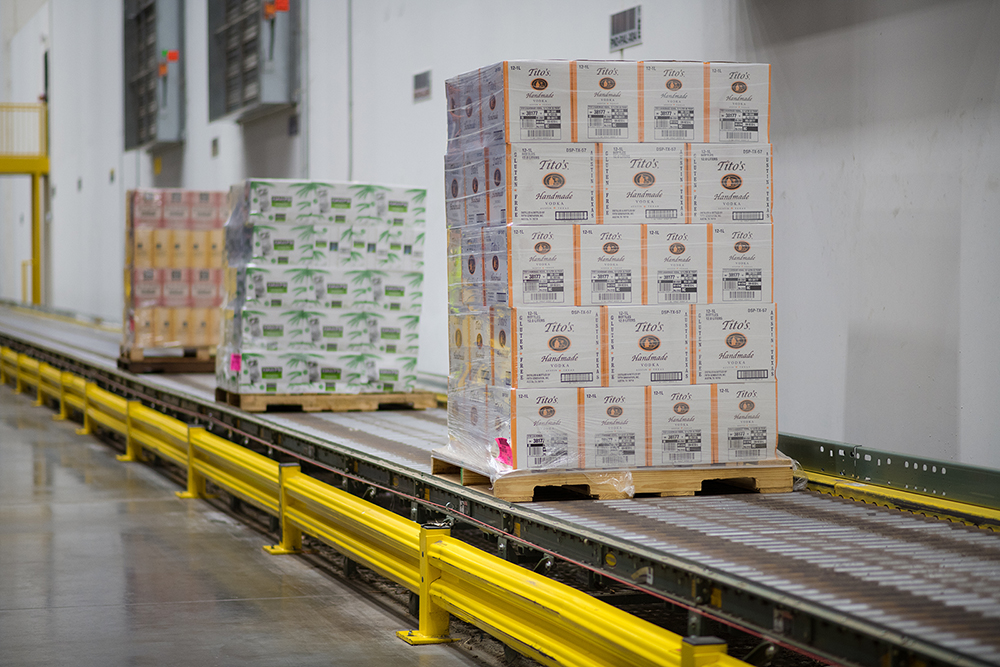
The best warehouse execution strategies integrate automated palletizing directly into upstream and downstream processes. Pallet conveyor systems and AS/RS-integrated palletizers ensure that palletizing keeps pace with picking and sorting, allowing for a seamless material flow.
- Bottlenecks at palletizing slow down the entire fulfillment process.
- Manual palletizing creates inconsistencies, requiring rework and slowing shipments.
- Automation ensures a continuous, synchronized flow, maximizing warehouse throughput.
When fully automated, palletizing extends your broader material handling system, eliminating bottlenecks and maintaining efficiency from start to finish.
4. Pallet Consistency is Critical to Automation Success
The physical pallet structure itself is an often-overlooked critical success factor to making automation work as effectively as possible. Damaged pallets, variable pallet sizes and styles, and even materials can impact your automation system’s uptime and efficiency.
Deciding what pallets to use in your system that will best accommodate your equipment is important to make sure it can be effectively and safely handled by all your automation.
- Pallet style impacts the automation selection and design. GMA, Peco, CHEP, Euro and more can potentially be handled differently by various automation.
- Pallet environment impacts pallet material with composite pallets having a higher cost but offering greater consistency and control (especially in wet environments).
- Pallet composition impacts durability and cost. Wood or wood composite pallets have a shorter lifespan than composites but also represent a lower cost.
Additionally, your suppliers may have various pallet styles on which the product is delivered, necessitating either a restacking effort or the use of a bearer pallet (a pallet or pallet-like structure that the palletized load is placed on to standardize the pallet-to-equipment handling).
By determining your best method to standardize your pallet consistency, you’ll maximize the efficiency of your automation systems and ensure that downtime due to pallet failure is minimal.
5. Future-Proofing Operations Requires Scalable Automation
Warehouses, distribution centers and manufacturing facilities aren’t static. As businesses scale, their palletizing needs become more complex and require flexible solutions that adapt to evolving order profiles, SKU variations, and increasing volumes.
Modern robotic palletizing systems are designed for scalability. Whether handling mixed-SKU loads, accommodating packaging changes, or integrating with predictive analytics software, these systems evolve alongside operational needs.
- Scaling manual palletizing means hiring more workers, which isn’t a sustainable long-term solution.
- Robotic palletizing adapts to changing demand, ensuring future-ready operations.
- AI-driven automation helps businesses optimize palletizing strategies in real-time, improving efficiency and reducing costs.
By implementing a flexible, scalable palletizing solution, businesses can position themselves for long-term success without worrying about labor shortages or capacity constraints.
The Key to Complete Warehouse Optimization For New and Existing Operations
Palletizing is often treated as an afterthought but it is crucial in optimizing material handling operations. Whether designing a greenfield facility from the ground up or looking to improve efficiency in an existing operation, automating this step ensures that your entire workflow operates at peak performance.
For new facilities, automation allows them to build a scalable, future-ready system that integrates robotic palletizing, AS/RS, and conveyor systems from day one, eliminating inefficiencies before they start. For brownfield sites, integrating automation into existing processes, whether through semi-automated palletizing, robotic cells, or software-driven optimization—helps increase throughput, reduce labor costs, and improve product handling without requiring a complete system overhaul.
By automating palletizing, your operation gains:
- Higher throughput with precision-built pallets ready for transport.
- Lower labor costs and improved worker safety by eliminating manual lifting.
- Seamless storage and handling with properly structured loads that integrate into AS/RS and conveyors.
Partnering with Bastian Solutions means collaborating with a trusted material handling automation integrator dedicated to optimizing your operations. Our team brings deep expertise in material handling, robotics and system design to create solutions that fit your operational needs. From concept to implementation and beyond, we work closely with you to streamline processes, increase throughput, and prepare your facility for long-term success.
Ready to take your operation to the finish line? Download our Enhancing ROI with Automated Palletizing whitepaper to explore solutions and best practices for palletizing automation in greenfield and existing facilities.
Or, talk to a Bastian Solutions engineer about automation solutions tailored to your palletizing needs.
Matthew is a New Business Development Consultant for Bastian Solutions.
Comments
No comments have been posted to this Blog Post
Leave a Reply
Your email address will not be published.
Comment
Thank you for your comment.